
- ◆Why the first AI draft is rarely the best one, and why that is not a problem with the tool or the prompt.
- ◆The four follow-up prompts that fix most first drafts without starting again.
- ◆A full iteration loop from first prompt to something worth sending. Three follow-ups, eight minutes, estate agent portal lead reply.
- ◆When to edit and when to scrap and restart. A quick test that tells you which one applies.
- ◆A reference list of the follow-up prompts used most often in UK property work.
- ◆Before and after examples for estate agents, letting agents, and mortgage brokers.

Four posts in, you have a complete prompting method. Specific task. Solid context. A precise role. Tone and format locked down.
And the first draft still is not quite right.
That is normal. Even a well-written prompt leaves room for interpretation. The difference between people who find AI useful and people who give up after the first attempt is not the quality of their prompts. It is what they do after the first response comes back.
Most people do one of two things. They accept the output anyway, fix it manually, and spend more time editing than they would have spent writing from scratch. Or they scrap it, start again from a blank box, and repeat the same cycle.
There is a third option. Push back.
One targeted follow-up prompt produces a second draft that is almost always closer to what you needed. Two or three follow-ups and you have something you send. The whole process takes less time than writing it yourself and less time than a full restart.
Why the First Draft Is Not Always Good Enough
A prompt is a brief. Even the best brief leaves room for interpretation. AI fills that room with the most statistically likely response to what you wrote. Sometimes that lands exactly where you needed. Often it lands close but not quite there.
That is not a failure. It is how the process works.
The first draft tells you something useful. It shows you which parts of the brief AI interpreted correctly and which parts it guessed at. A follow-up prompt corrects the guess. That is faster than rewriting the whole brief from scratch.
The mistake is treating the first response as a verdict on whether AI is useful for the task. It is not a verdict. It is a starting point.
What a follow-up prompt actually does
A follow-up prompt does not restart the conversation. AI remembers everything in the current chat. A follow-up builds on the first response. You are editing the output by giving AI a more precise instruction about what to change, not asking it to begin again.
The Four Follow-Up Prompts Worth Knowing
These cover the most common reasons a first draft misses. Each one is short. Each one produces a noticeably different second draft.
“The tone is too formal. Rewrite it to sound more direct and personal.”
“This is too long. Cut it to 80 words. Keep the key information.”
“Remove the last paragraph. It sounds like a sales pitch.”
“Rewrite this as two short paragraphs. Remove the bullet points.”
None of these require you to explain the whole task again. AI already has the context. You are giving it one specific editorial instruction. That is the entire follow-up prompt.
The shorter and more precise the instruction, the better the second draft. “Make it better” is the least useful follow-up prompt in existence. “Cut the third sentence and make the sign-off more direct” is the most useful.
A Full Iteration Loop
This is the section worth reading twice. A complete example from first prompt to something worth sending. Three follow-ups. Eight minutes total.
The task: an estate agent needs to send a portal lead reply to someone who enquired about a three-bedroom semi at £265,000.
“Act as an experienced UK estate agent. Write a portal lead reply to someone who enquired about a three-bedroom semi in Nottingham at £265,000. Tone: friendly and professional. Ask one question back about their timeframe. Under 80 words. Sign off with first name.”
First draft: reasonable. Friendly enough. Asks about timeframe. But the opening line is “Thank you so much for your enquiry regarding the above property” and the sign-off is three lines long. Not terrible. Not good enough.
“The opening line sounds like a template. Rewrite it to start with something more direct and personal. Keep everything else.”
Second draft: better opening. Still has “I would be more than happy to arrange a viewing at your earliest convenience.”
“Remove the phrase more than happy and at your earliest convenience. Rewrite that sentence.”
Third draft: almost there. Slightly over 80 words.
“Cut this to 75 words without losing the question about timeframe.”
Final output: something a negotiator would send without editing. Three follow-ups. The whole thing took less time than writing it from scratch and produced a better result than the original prompt alone would have.
The iteration is the skill. Most people never try it.
For a full set of portal lead reply templates that already have the common problems fixed, the Rightmove and Zoopla enquiry guide has six ready-to-use prompts.
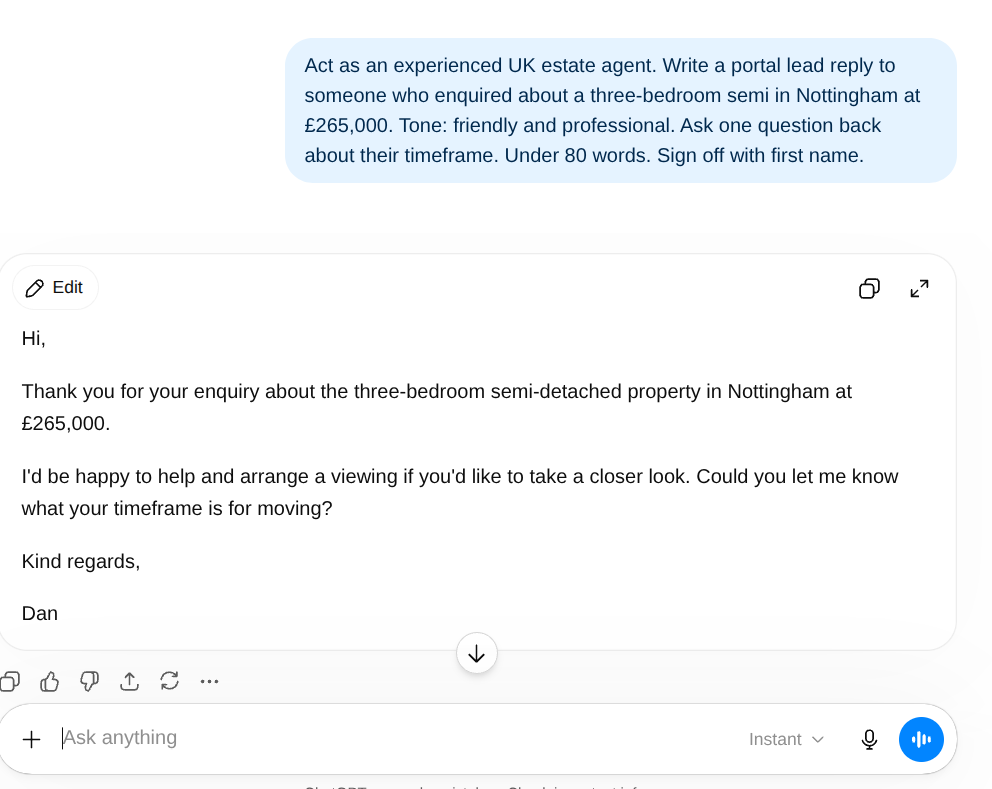
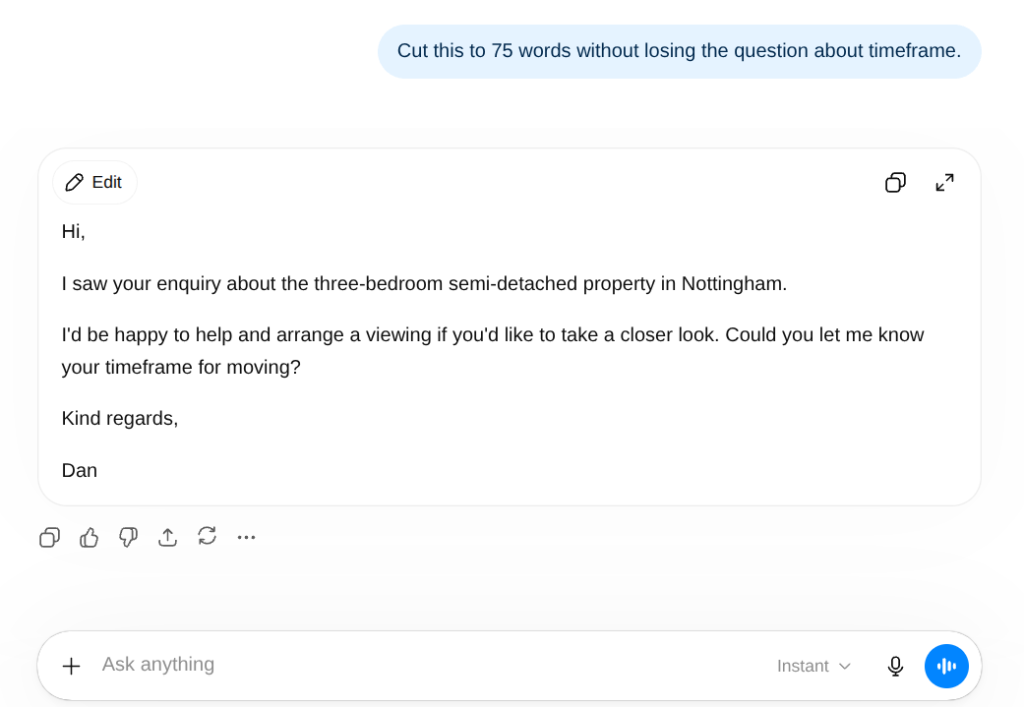
First draft above. Three follow-up prompts later after. Same original prompt both times.
When to Edit and When to Start Again
Not every first draft is worth iterating on. Some need a restart. Here is how to tell the difference quickly.
Edit instead of restarting when: the structure is broadly right, the information is mostly there, and the tone is close. If you are adjusting less than half of it, follow-up prompting is faster than starting again.
Restart when: the task was wrong in the prompt, the context was missing or incorrect, or the output is the right words arranged in completely the wrong order throughout. If you are rewriting more than half of it, the prompt was the problem. Fix the prompt, not the output.
One thing worth trying before you restart: read the first draft again before closing the tab. More often than not there is a usable structure underneath the parts that feel wrong. One follow-up prompt surfaces it.
Keep the prompts that produced good output
When a prompt plus two or three follow-ups produces something you send, save the full sequence. Not just the original prompt. The follow-ups tell you what to add to the original next time. Over a month of doing this, your base prompts improve because you are building the fixes in from the start. The context block from Post 2 is the right place to store them.
The Follow-Up Prompts That Save the Most Time
A reference list. The ones used most often in UK property work.
“Shorter.” The most common follow-up. Paste a target word count alongside it. “Shorter, under 90 words” is more effective than “shorter” on its own.
“More direct.” Removes padding in one instruction. Works on any output that sounds hedged or corporate.
“Plain English.” Particularly useful for mortgage broker and compliance-adjacent writing where AI defaults to formal language.
“Remove [specific phrase or word].” Faster and more precise than asking AI to generally improve the tone. Name the exact thing to cut.
“Rewrite just the [opening / second paragraph / sign-off].” Surgical editing without redoing the whole output. Use this when most of the draft is good and one section is pulling it down.
“Add [specific detail].” When something is missing from the output. Faster than restarting with a longer prompt.
“The [section] sounds too [adjective]. Rewrite it.” The most versatile follow-up format in the list. “The opening sounds too formal. Rewrite it.” “The last paragraph sounds too pushy. Rewrite it.” Works on any section, any problem.

Before and After: Three Property Roles
Estate Agent: Vendor Update
“Act as an experienced UK estate agent. Write a vendor update email. The property has been on the market nine weeks with no offers. Two second viewings next week. Tone: warm and honest. Under 120 words.”
Opens with “I hope this email finds you well.” Ends with “please do not hesitate to contact me should you have any queries.”
“Remove the opening pleasantry and start with the update. Replace the sign-off with a specific invitation to call this week.”
What changes: the email now starts with the situation and ends with a clear next step. Reads like a person wrote it.
Letting Agent: Maintenance Update to Landlord
“Act as a UK property manager. Write a maintenance update to a landlord. The boiler repair was completed yesterday. Final cost was £340, within the agreed limit. Tone: factual and brief. Under 80 words.”
Three paragraphs when two would do. Second paragraph repeats information already in the first.
“The second paragraph repeats the cost information from the first. Remove it and combine into two short paragraphs.”
What changes: tighter, no repetition, reads like a professional update rather than a drafted document.
Mortgage Broker: Chasing a Client for Documents
“Act as an FCA-regulated UK mortgage broker. Write a polite but clear email chasing a client for their last three months of bank statements. Application cannot proceed without them. Tone: friendly but direct. Under 80 words.”
Buries the urgency. The fact that the application cannot proceed without the documents appears in the third sentence.
“Move the information about the application being on hold to the first sentence. Everything else can stay.”
What changes: one sentence repositioned. The email communicates the urgency immediately without changing the tone.
What the Full Method Looks Like in Practice
Across five posts you have built a prompting method with five layers.
Specificity. One task, one prompt, stated clearly at the start.
Context. Who you are, what the situation is, who the reader is.
Role. The professional identity that shapes the register of everything that follows.
Tone and format. How the output should sound and what it should look like.
Iteration. The follow-up prompts that close the gap between near-miss and something worth sending.
None of it is complicated. Most of it sticks after the first time you use it.
The property professionals getting the most from AI right now are not the ones with the most technical knowledge. They are the ones who treat the first draft as a starting point, not a verdict, and who have built enough of a system that the prompts take thirty seconds to write rather than five minutes.
One thing that does not change
AI still makes things up. It still produces plausible-sounding output that is factually wrong. Everything in this series improves the quality of what AI produces. None of it removes the need to check what goes out before it reaches a client. Tone and format first. Human review before it leaves your inbox. Always. The guide to why AI gets things wrong covers what to watch for and when.

Where to Go From Here
This series covered the skill of prompting. The AI for Property section covers how UK estate agents, letting agents, and mortgage brokers are putting those skills to work on the specific tasks that take up most of their week. That is where the prompting method from this series gets applied to the work you do every day.
If you want to go further than prompts entirely and remove the task from your week rather than just speed it up, the Automate Your Business series covers that end to end. The lead follow-up automation guide is a good place to start if you want to see what that looks like in practice.
All five posts in one place
Post 1: Why your prompts are not working and the simple fix.
Post 2: How to give AI the context it needs to help you properly.
Post 3: How telling AI to play a role gets you far better results.
Post 4: How to control the tone and format of every AI response.
Post 5: How to refine AI output until it is good enough to send. This post.
Want Someone to Build the Automations Around These Prompts?
Better prompts produce better output. Automation removes the task from your week entirely. If you want to see what that looks like for your property business, the Discovery Audit is where it starts. One session, a clear report, and a specific plan for what is worth building first.
Book a Discovery Audit →Questions People Actually Ask
Send a specific follow-up prompt rather than starting again. Name exactly what to change. The opening sounds too formal, rewrite it produces a better second draft in seconds.
Include a word count in your follow-up. Cut this to 80 words, keep the key information is more reliable than asking AI to shorten it without a target.
The most specific one you write. Remove the last paragraph, it sounds like a sales pitch outperforms make it better every time.
Usually two or three. If you are still not happy after four, the original prompt was the problem. Fix the prompt and start that task again.
When you are rewriting more than half the output. If the task, context, or role was wrong in the original prompt, iteration will not fix it. Correct the prompt and run it again.
Yes, within the same chat session. AI uses everything in the current conversation when producing each new response. Start a new chat and that memory resets completely.
How to Control the Tone and Format of Every AI Response
Before iterating on output, it helps to have tone and format locked into the original prompt. Post 4 covers exactly how to do that.
Read Part 4 →