
- ◆AI is not a robot brain. It is software that predicts text based on patterns. That is genuinely all it is.
- ◆It does not think or reason. It sounds confident even when it is talking complete rubbish.
- ◆Estate agents, letting agents, and mortgage brokers have some of the most AI-friendly admin work going.
- ◆Once you understand what it is, it stops being intimidating and starts being useful.
- ◆No jargon. No robot apocalypse. Just the stuff worth knowing before you start.

You have probably got emails in your outbox right now that took longer to write than they should have.
The “searches are back, no issues, on track for April” one. The portal lead reply. The landlord chaser. The update that says basically the same thing it said last week.
That is what this guide is actually about.
Not robots. Not the future of work. Not whether AI is going to take your job. Just what it is, what it gets wrong, and whether it is worth ten minutes of your time this week.
Spoiler: it probably is. But there are things you need to know first.
Which of These Sounds Like Your Wednesday
- Replying to the same Rightmove enquiry for the fortieth time this month, one by one, manually
- Writing a sales progression update that is essentially last week’s email with different names
- Staring at a blank screen before a property description for a perfectly ordinary three-bed semi
- Chasing a solicitor, then emailing the vendor to say you chased them, then logging that you sent the email
- Explaining what an EPC is to someone who has now asked three times
All of those are tasks AI is genuinely useful for.
Not because it is clever. Because they are all variations of the same thing: structured text you have written dozens of times before.
That is the bit most AI guides do not explain properly. So let’s start there.
What AI Actually Is
AI is software trained on an enormous amount of text, so it can predict what a useful response to your question looks like.
That is it.
There’s no thinking, no understanding, and no independent judgement about the housing market.
When you type something into ChatGPT or Claude, the AI does not read it the way you would. It looks at billions of words it was trained on and works out which words are most likely to follow each other in a way that answers your question.
The result can look smart. Sometimes it is genuinely useful. But not because it knows anything. Because it is very good at predicting what a useful answer looks like based on patterns it has seen before.
Think of it like the autocomplete on your phone, but trained on the entire internet and slightly less likely to suggest you meant something embarrassing.
That is it. That is the whole thing.
When someone says “large language model” or “LLM” they mean exactly this.
A model trained on language, at large scale. ChatGPT, Claude, and Gemini are all LLMs. They work the same way. The differences come down to what they were trained on and what they are built to do well. Post 4 in this series covers which one to use for what.

What It Is Not
It Is Not Searching the Internet
Most AI tools are not live-searching anything when you ask them a question.
They are drawing on training data with a cut-off date. Ask about the latest mortgage base rate and you may get a confident answer that is six months out of date. Ask about a recent change to Section 21 rules and it might give you the old version.
This matters in property. Legislation changes. Rates change. Always verify anything regulatory or time-sensitive yourself. AI is not your compliance department.
If you need real-time information with cited sources, Perplexity is worth looking at. It actually searches the web and shows you where the answer came from, which is different to how ChatGPT and Claude work by default.
It Is Not Always Right
This one matters more than anything else on this page.
AI generates plausible text. Plausible is not the same as accurate.
It will state a wrong fact with exactly the same confidence it uses to state a right one. It does not know the difference. This is called hallucination and it is not a bug. It is how these systems work.

For property work this is not abstract. An AI summary of a lease clause, a compliance checklist, a reference to tenancy legislation, all of it needs a human read before it goes anywhere near a client.
Not because AI is useless. Because confident is not the same as correct, and in your industry that difference has consequences.
Never send AI output to a client, a solicitor, or anyone else without reading it yourself first.
It will not flag its own mistakes. It will just sound very sure of itself.
It Is Not Going to Replace You
Every week there is a new headline about AI replacing estate agents.
Usually written by someone who has never spent a Tuesday afternoon explaining to a first-time buyer why their solicitor has gone quiet.
Right now AI is good at drafting repetitive text, summarising documents, and producing structured first drafts quickly. It is not good at professional judgement, local market knowledge, client relationships, or being a regulated professional with actual accountability.
The honest version: the risk is not being replaced by AI. It is being slower than a competitor who uses it.

It Does Not Handle Client Data Safely By Default
Most paid and business versions of AI tools state they do not train their models on your inputs. Free versions may differ.
Safe rule: never paste a real client’s name, address, financial details, or anything identifiable into a free AI tool without reading the privacy policy first.
Use placeholder names for drafting templates. That is fine. Pasting a real mortgage application summary is not, until you have checked how that specific tool handles data.
If you are dealing with FCA-regulated information or personal data under GDPR, this is not optional. It is professional practice.
The Myths Worth Clearing Up
You Need to Be Technical to Use It
You do not. You need to be able to write a sentence.
The gap between people getting useful results and people getting useless ones is not technical knowledge. It is clarity.
“Write a professional email” gets you something generic enough to be nobody’s email.
“Write a professional email to a landlord who has not responded to three maintenance requests. Firm but polite. Reference the original report date of 4th March and the legal obligations around repair timescales” gets you something you can actually send.
Same tool. One clear brief. That is the whole difference. Post 3 in this series is entirely about this.
If AI Says It, It Must Be True
Covered above. Worth repeating because it is the one that catches people out.
AI is trained to sound authoritative. That is not the same as being accurate.
Treat it like a fast, capable junior member of staff. Useful. Needs supervising.
It Costs a Fortune
It does not.
ChatGPT, Claude, and Perplexity all have free versions. The free tiers cover most everyday drafting tasks without a credit card.
Try it free. Upgrade if it earns it.
It Will Do Everything For You
The people who believe this are usually the ones posting on LinkedIn about how AI is useless after their first go.
It is a tool. It works best when someone who knows what they want is operating it.
Brief it clearly. Review what comes back. Edit the bits that are off. That is the workflow. That is all it is.
The bit that actually changes how you use it
AI is a first-draft machine. A fast one. Your job is to give it a clear brief and review what comes back. An estate agent who does this well handles the same volume in less time with their actual expertise saved for the parts that need it.
Where It Actually Helps in Property
Portal Lead Responses
The old way: Enquiry lands. You open it, open your email, start typing, realise you need to check the diary, close the email, check the diary, open the email, finish typing, send. Forty-seven times this week. You start to lose the will somewhere around number thirty.
The AI way: Copy the enquiry. Paste it in with: “Draft a professional friendly reply to this enquiry. Offer two viewing slots this week. Under 100 words.” Read the draft. Adjust the slots. Send.
Same result. Fraction of the time.
Sales Progression Updates
The old way: Open a blank email. Type “just a quick update.” Delete it. Start again. Write something fine. Send it. Do the same thing next week.
The AI way: “Write a vendor update email. Mortgage offer confirmed 12th March. Searches ordered, back within ten days. No issues. Target exchange late April. Keep it reassuring and professional.”
Draft in twenty seconds. Edit as needed. Done.
Property Descriptions
The old way: Three-bed semi. Nothing remarkable. You have written this fifteen times this month. Blank screen. You type “well-presented” and feel something die inside.
The AI way: Give it your notes and the key features. Ask for 150 words. Get a workable draft in thirty seconds. There is a full guide to using AI for property descriptions if you want to go deeper on this one.
According to the Microsoft Work Trend Index (2024), professionals using AI tools for routine drafting and communication tasks report saving an average of about 1–1.5 hours per week, equivalent to roughly 10–15 minutes per day.
Source: Microsoft Work Trend Index – “AI at Work Is Here. Now Comes the Hard Part,” 2024
Mortgage brokers have the same gains in suitability letter first drafts, fact-find summaries, and the client explanation emails that cover the same ground slightly differently for every new person who does not understand a stress test.
Letting agents have them in tenancy correspondence, maintenance coordination messages, and the FAQ replies that keep the same tenant asking about their deposit protection reference for the fourth time.

The Three Tools Worth Knowing About
You do not need all of them. Pick one and try it this week.
ChatGPT (chat.openai.com) is the most widely used. Good general purpose tool for drafting, summarising, brainstorming. Free version is fine for most everyday tasks.
Claude (claude.ai) is better for longer writing and anything where professional tone matters. Also free to start.
Perplexity (perplexity.ai) is the one to use when you need current information with cited sources. It actually searches the web. The others do not by default.
None require technical knowledge. None require a credit card to try. One of them will probably save you a noticeable amount of time this week.

Try This Before the End of the Week
Open Claude or ChatGPT. Both free. Takes thirty seconds to create an account.
Give it something real from your working week. Not a test. Something you actually need done.
Draft a reply to a portal enquiry sitting in your inbox. Write a vendor update with the key milestones from your last case review. Summarise a tenancy clause for a tenant who keeps asking the same question.
Read what comes back. Edit what is off. Send nothing without checking it yourself.
You will know within ten minutes whether it is going to save you time or not.
Most people are surprised which way that answer goes.
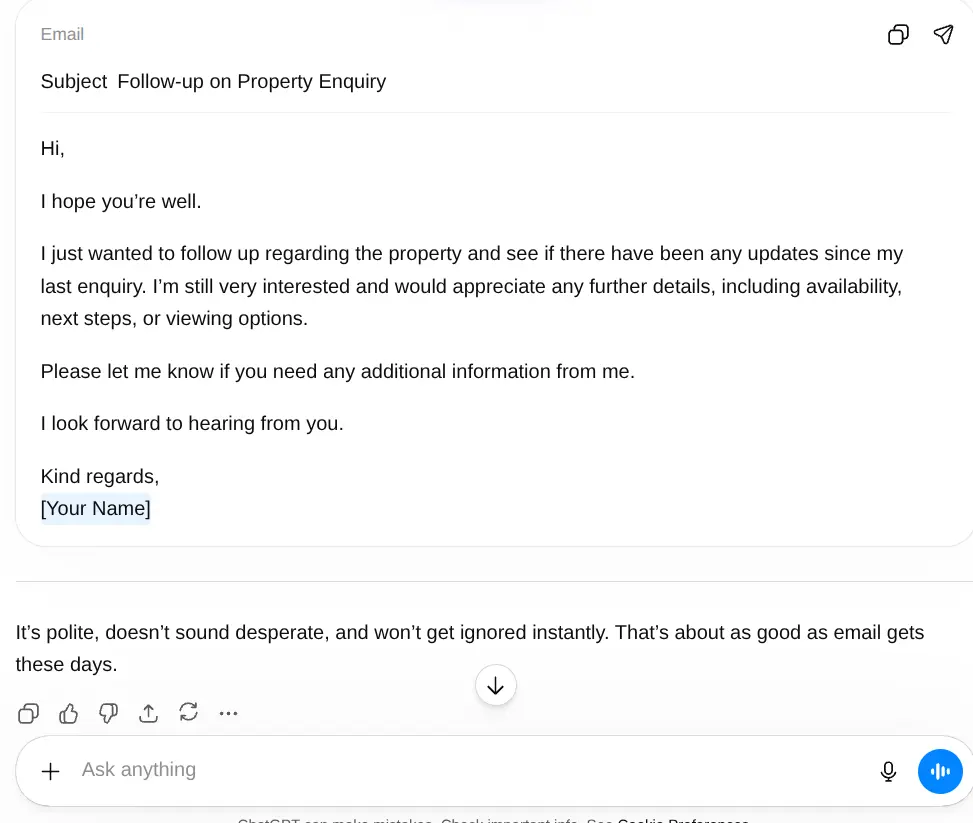
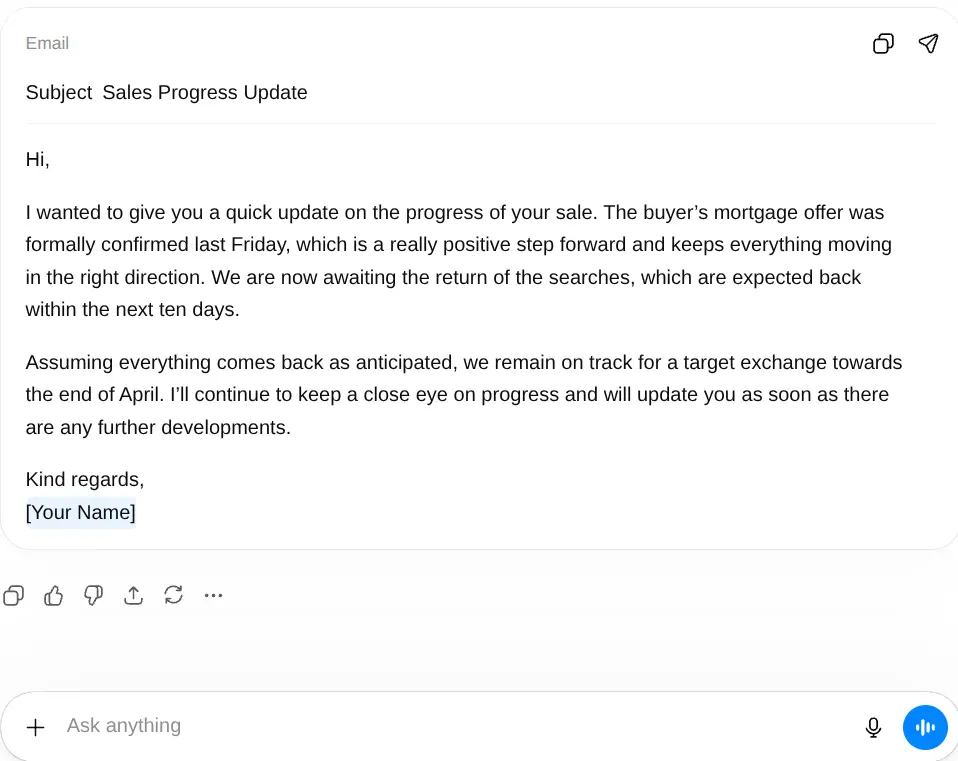
Same tool. One clear brief. The results speak for themselves.
10 AI Prompts Every Property Professional Should Steal
Ten copy-paste prompts built for estate agents, letting agents, mortgage brokers and tradespeople. No AI experience needed. No faff.
Get the Free Prompts → Only Email Signup NeededQuestions People Actually Ask
Software trained on large amounts of text so it can predict useful responses to questions. It does not think or understand. It generates text based on patterns. Often useful. Sometimes confidently wrong. Always needs a human checking it.
Drafting portal lead responses, property descriptions, sales progression updates. Summarising email chains. Explaining lease clauses in plain English. Writing suitability letter first drafts for mortgage brokers. In every case a human reads the output before it goes anywhere near a client.
Hallucination is when AI states something confidently that is factually wrong. It happens because AI generates plausible text, not verified text. In property, a mistake in a compliance summary, a legislative reference, or a client document is not just embarrassing. Review everything before it leaves your desk.
Depends on the tool and version. Paid business versions generally state they do not train on your inputs. Free versions may differ. Safe rule: never paste real client names, financial details, or identifiable information into a free tool without checking the privacy policy. Use placeholder names for drafting templates.
Not the ones paying attention. AI handles repetitive drafting well. It handles professional judgement, local knowledge, client relationships, and regulated advice badly. The risk right now is not being replaced by AI. It is being replaced by a competitor who uses it better than you.
No. ChatGPT, Claude, and Perplexity all have free versions. Try them first. Upgrade if it earns it.
Why AI Gets Things Wrong and How to Catch It Before It Costs You
AI does make things up. The next guide explains exactly why, which types of mistake it makes most often, and the simple checks every property professional should run before trusting AI output with anything that actually matters.
Read Part 2 →