
- ◆AI output quality depends almost entirely on how clearly you ask.
- ◆Vague prompt, vague result. Clear brief, useful output. Every time.
- ◆This guide gives you a five-part formula, a copy-paste template, and six property-specific examples for estate agents, letting agents, and mortgage brokers.

The quality of what you get from AI depends almost entirely on how you ask. That is what this guide is about.
The tool is not the problem. The question is.
Most people type something vague, get something generic back, and conclude AI is not useful. Someone else types a clear brief into the exact same tool and gets something they can send in thirty seconds.
Same tool. The difference is how they asked.
What You Will Learn
– Why vague prompts produce useless results and how to fix it
– The five-part formula that works for almost any property task
– A copy-paste prompt template you can adapt straight away
– Six before and after examples for estate agents, letting agents, and mortgage brokers
– The four mistakes that waste the most time
Why Vague In Means Vague Out
Go back to what AI actually is: software that predicts what a useful response looks like based on your input.
If your input is vague, the response will be vague too. AI is not reading your mind or filling in missing detail for you. It can only work with what you give it.
That is why a loose brief usually produces something generic, while a proper brief gives you something usable.
Weak brief:
“Write a letting email.”
Better brief:
“Write a short email to a tenant reminding them that the annual gas safety inspection is due next week. Keep the tone polite, clear, and professional. Ask them to reply with a suitable time.”
That is enough detail for AI to produce something useful.
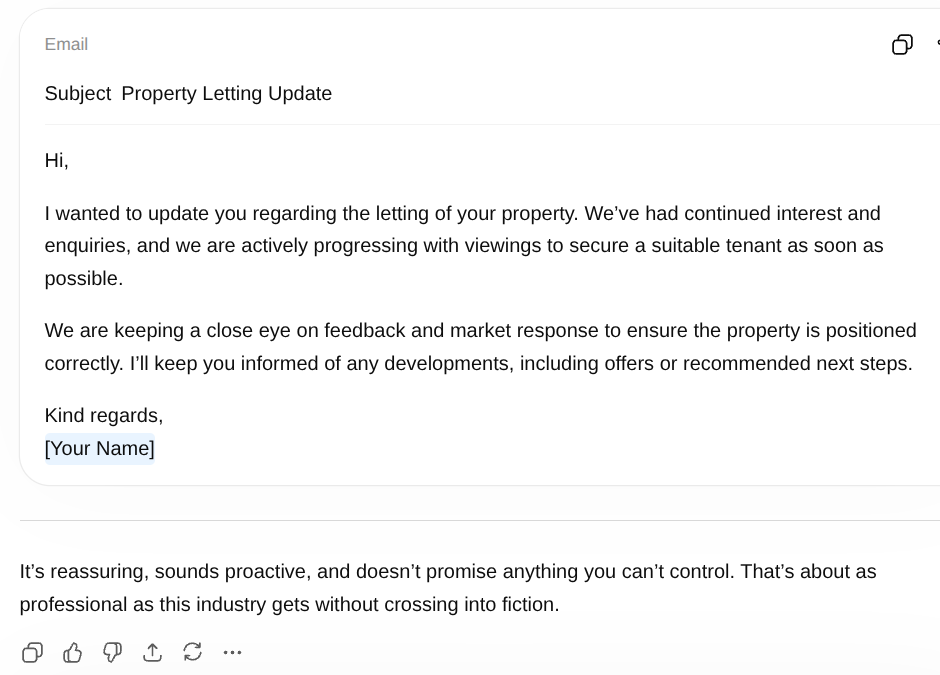
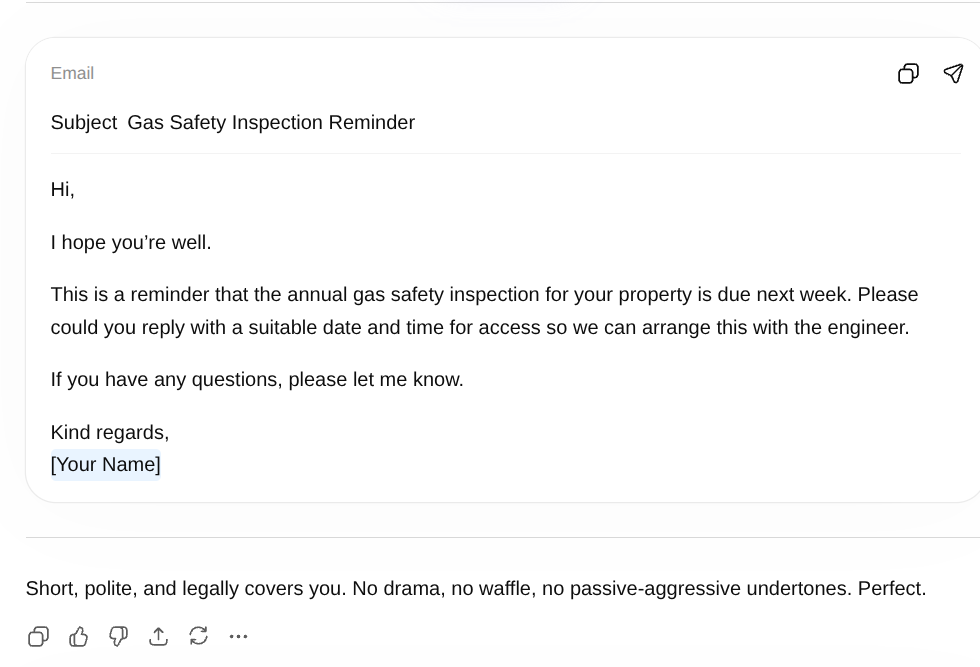
Same tool. Better brief. Much better output.
How to Write an AI Prompt: The Five-Part Formula
You do not need a system. You need a checklist you run in your head before you hit send.
Most good prompts have five things in them. You do not always need all five. But the more of them you include, the better the result.
1. The Task
What do you actually want it to produce? Be specific about the format.
Not “something about this property.” Write a two-paragraph description. Draft a follow-up email. Summarise this in three bullet points. Create five subject line options.
The task is the first thing in your prompt. Always.
2. The Context
What does AI need to know to do this properly?
For a property description: the key features, target buyer, location, any selling points. For a client email: who you are writing to, what has happened, what they need to know. For a compliance summary: which regulation, which situation, which part you need explained.
3. The Tone
How should it sound?
Professional and warm. Firm but fair. Reassuring. Direct. Formal. Friendly. You know your client better than AI does. Tell it.
If you skip this, AI picks a default tone. Sometimes that is fine. Often it is slightly off in a way that is hard to put your finger on.
4. The Format
How long? What structure?
Two paragraphs. Under 100 words. Bullet points. A numbered list. An email with a subject line. A table with three columns.
If you do not specify, AI chooses. Sometimes it over-delivers and you get five paragraphs when you wanted two. Tell it what you need.
5. Any Constraints
What should it avoid? What rules apply?
No jargon. Do not mention the price. Avoid mentioning the neighbour situation. Keep it compliant with FCA guidelines. Do not make any guarantees about timescales.
Constraints are the most skipped part. They are also what stops you having to edit out the thing AI always adds that you did not want.
The formula in plain English
Task + Context + Tone + Format + Constraints. You do not need all five every time. A simple task only needs the first two. Higher stakes tasks benefit from all five. Once this becomes habit, writing prompts takes about ten seconds longer than writing a vague one.
| Element | What to include | Property example |
|---|---|---|
| Task | What you want produced and in what format | Write a two-paragraph vendor update email |
| Context | What AI needs to know about the situation | Mortgage offer confirmed, searches ordered, no issues |
| Tone | How it should sound | Reassuring and professional |
| Format | Length and structure | Two paragraphs, under 150 words |
| Constraints | What to avoid or not include | No guarantees on timescales |
Your Copy-Paste Starting Template
Fill in the brackets. Delete anything that does not apply.
“Write a [format and length] to [who and why]. Key details: [what AI needs to know]. Tone: [how it should sound]. Do not [what to leave out].”
“Write a two-paragraph email to a vendor whose buyer had their mortgage offer confirmed yesterday. Key details: searches ordered, expected back in ten working days, no issues, target exchange mid-May. Tone: reassuring and professional. Do not make any guarantees on the timeline.”

AI Prompt Examples for Estate Agents, Letting Agents and Mortgage Brokers
Six tasks. Six before and after prompts. Copy, swap the details, use today.
Portal Lead Response — Estate Agent
“Write a reply to a property enquiry”
“Write a friendly professional reply to a Rightmove enquiry about a three-bed semi in Nottingham priced at £285,000. The person asked about viewing availability. Offer two slots: Tuesday 2pm and Thursday 10am. Keep it under 80 words. Do not include the asking price in the reply.”
For a full walkthrough of handling portal enquiries this way, including reply templates you can use today, see the guide on replying to Rightmove and Zoopla enquiries with AI.
Vendor Update Email — Estate Agent
“Write a vendor update”
“Write a two-paragraph vendor update email. Buyer’s mortgage offer was confirmed yesterday. We are now waiting on searches which are expected back within ten working days. No issues to flag. Target exchange is mid-May. Keep it reassuring and professional. Do not give any guarantees on the timeline.”
Property Description — Estate Agent
“Write a property description”
“Write a 150-word property description for a three-bedroom mid-terrace in Arnold, Nottingham. Key features: recently refurbished kitchen, south-facing garden, driveway for two cars, close to good primary schools. Target buyer is a young family. Warm and welcoming tone. No clichés like ‘stunning’ or ‘must be seen to be believed’.”
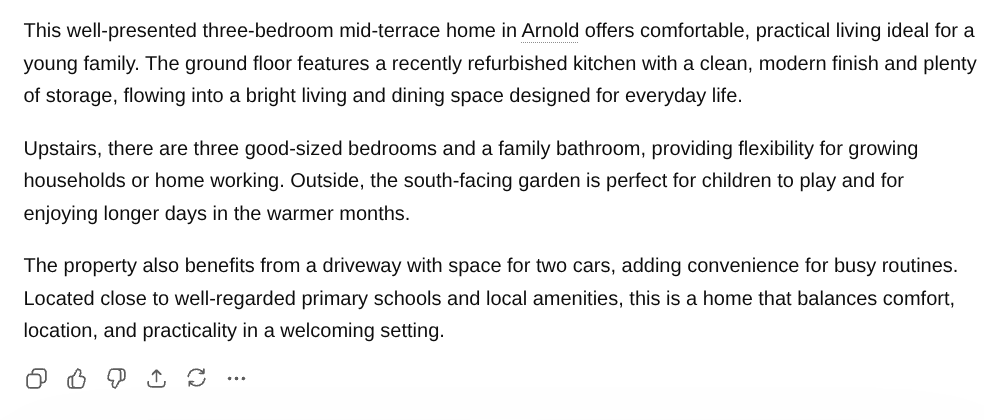
If property descriptions are a regular time drain, there is a full guide to writing AI property descriptions that goes deeper on this specific task.
Tenant Arrears Chaser — Letting Agent
“Write an email to a tenant about rent”
“Write a firm but professional email to a tenant who is fourteen days late with their rent payment. This is the first missed payment in an eighteen-month tenancy. Acknowledge this may be an oversight. Ask them to contact the office within 48 hours to arrange payment or discuss their situation. Keep it under 100 words. Do not use threatening language.”
Landlord Maintenance Email — Letting Agent
“Write an email to a landlord about a repair”
“Write a professional email to a landlord informing them that a tenant has reported a broken boiler. The repair was reported three days ago and the tenant is without heating. The tone should be firm but professional. Reference the landlord’s legal obligation to maintain heating. Keep it under 150 words.”
Suitability Letter Introduction — Mortgage Broker
“Write a suitability letter introduction”
“Write a two-paragraph introduction for a mortgage suitability letter. The client is a first-time buyer, 34 years old, employed full time as a teacher in Leeds. Purchasing a two-bed flat for £195,000 with a 10% deposit. They chose a two-year fixed rate due to wanting payment certainty. Keep it professional and FCA-compliant in tone. Do not include any specific product recommendations in this section.”
The landlord maintenance and suitability letter examples reference legal and regulatory obligations. AI will produce something that sounds accurate. It may not be. Always have compliance references and anything touching FCA requirements checked by someone qualified before they go to a client or a file.
Skip the Blank Box
The Prompt Machine builds your brief for you. Pick your property task, answer three questions, and it writes a prompt you can paste straight into ChatGPT or Claude. You get a first draft in under two minutes instead of staring at a blank input box wondering where to start. Free.
Try the Prompt Machine → Free. No signup.AI Prompting Mistakes That Cost You Time
Asking for Too Many Things at Once
One prompt, one task.
“Write me a property description, a social media caption, and a follow-up email” gets you three mediocre outputs. Three separate prompts gets you three good ones. Takes about the same amount of time.
Not Giving It Enough to Work With
AI cannot invent context you have not given it.
If you want a property description and you give it nothing beyond “three-bed house in Leeds,” that is exactly what it works with. The output will be so generic it fits every property and none of them. Give it the key features, the target buyer, the tone, the selling points.
Accepting the First Draft
AI output is a first draft. Not a finished piece.
If the first result is not quite right, push back rather than starting again. “Make it shorter.” “Change the tone to be warmer.” “Add a line about the garden.” “Remove the bit about the location.” The second or third version is almost always better than starting from scratch.
Forgetting to Check It
Covered in the guide on why AI gets things wrong. A well-written prompt reduces the amount of editing. It does not remove the need to read what comes back before it goes anywhere.
Writing the Prompt in the Wrong Order
A common one. People lead with the context and bury the task at the end. Lead with what you want: “Write a vendor update email” then add the context after. The output is noticeably better.
Writing the Same Prompt Every Time
If you write the same type of prompt regularly, save it. A portal lead reply prompt you wrote once is the one you use forever. Just swap the property details each time.

One Tool Worth Knowing About
If the five-part formula still feels like extra work, the Prompt Machine does the briefing for you. Pick your task, answer three questions about your situation, and it writes the prompt. You copy it, paste it into ChatGPT or Claude, and you are done.
It is the difference between starting from a blank box and starting from a brief that is already 80% there. Free. Takes about sixty seconds.
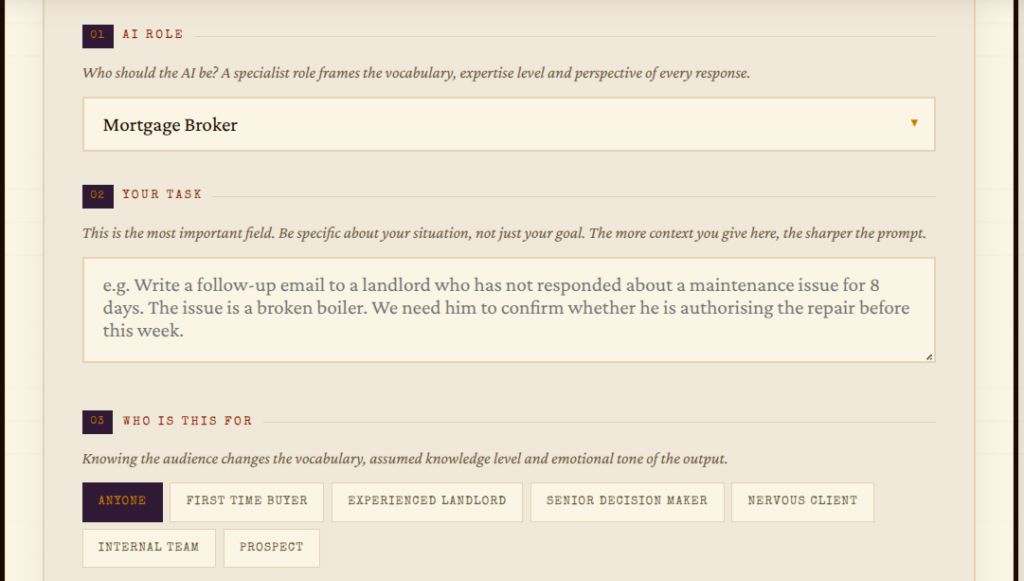
Your Prompt Library After One Month
The first prompt takes the longest. You are thinking about the five elements, working out what context to include, checking the constraints.
By the third or fourth time you write one, it is just a habit. Ten extra seconds before you type. Less editing after.
After a month of doing this, you will have a small set of saved prompts covering your most common tasks. Portal lead reply. Vendor update. Property description. Maintenance chaser. Each one refined from the first version you wrote.
You are not building a system. You are just saving the ones that worked.
Save the ones that work
When a prompt produces a result close to what you would have written, save it. A Notes app, a Word doc, anywhere. That prompt for a portal lead reply you wrote today is the one you use for every portal lead reply from now on. Just swap the property details. Within a fortnight you will have a library covering most of your regular tasks.
Try This Before the End of the Week
Pick one email you write regularly. The one you copy from a previous version every time and edit slightly. Portal lead reply, vendor update, maintenance chaser. Whatever it is.
Write a prompt for it using the five-part structure. Task, context, tone, format, constraints. Or use the copy-paste template above. Paste it into ChatGPT or Claude.
See how close the first draft is to what you would have written yourself.
Then save that prompt. Use it next time. Edit the specific details as needed. That is your first reusable prompt template.
10 AI Prompts Every Property Professional Should Steal
Ten copy-paste prompts built for estate agents, letting agents, mortgage brokers and tradespeople. No AI experience needed. No faff.
Get the Free Prompts →Questions People Actually Ask
The instruction you type into an AI tool. The quality of the prompt determines the quality of what comes back. Vague in, vague out.
Include five things: the task (what you want), the context (what AI needs to know), the tone (how it should sound), the format (length and structure), and constraints (what to avoid). You do not need all five every time. Start with the first two and add more as the task gets more complex.
As long as it needs to be. For a simple task, two or three sentences. For a complex one, ten or fifteen. Length is not the issue. Specificity is.
No. Please and thank you do not affect the output. Being specific does.
Push back rather than starting again. “Make it shorter.” “Change the tone.” “Remove the last paragraph.” The second version is almost always better than the first.
Yes. Save any prompt that produces a result close to what you would have written. Use it as a template next time. Change the specific details, keep the structure. That is how you build a prompt library without trying.
Portal lead replies, vendor and buyer update emails, and property descriptions. For each one, include the property type, the specific situation, the target reader, and a word count. The more specific the context, the less editing the output needs.
Tenant communication emails are the biggest time-saver. Arrears chasers, maintenance updates, tenancy renewal notices, and landlord progress emails. Always include the tenancy details, the situation, and a tone constraint. Never ask AI to cite specific legislation without checking it independently first.
Suitability letter introductions, fact-find summaries, and client explanation emails. Always include the client’s specific circumstances, specify an FCA-compliant tone, and constrain AI from making product recommendations unless you have included verified product details. Review everything compliance-adjacent before it goes to a client.
A bad prompt could mean almost anything. A good prompt could only mean one thing. The more precisely you describe the task, context, tone, format, and constraints, the less guesswork AI has to do.
ChatGPT vs Claude vs Gemini: Which One Should You Actually Use?
You now know what AI is, why it gets things wrong, and how to ask it better questions. The next guide covers which tool to use for which task. They are not all the same and picking the wrong one for the job costs you time.
Read Part 4 →